
My home coffee setup
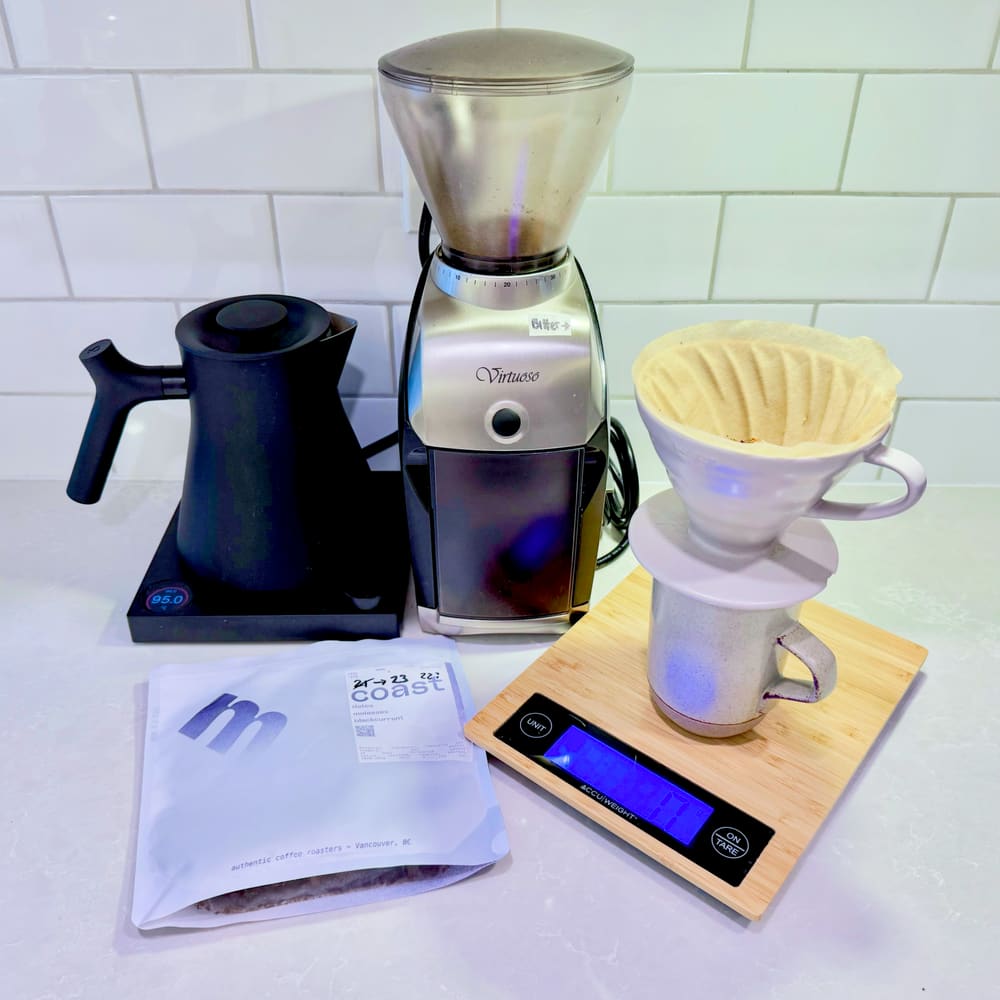
The best way to make coffee at home is making it the way you like, of course. But if you’re looking for new ideas here’s my setup.
This ended up being more of a rabbit hole than I was expecting and it’s pretty detailed, so feel free to skip around.
The gear
-
Brewer – I brew exclusively pourover these days. I’ve gone through French press / cafetière and Aeropress phases in the past (and still bring the latter along with me on trips) but for daily consumption I turn to a Hario V60. The ceramic models are more expensive and less ideal for heat absorption unless you pre-warm them, but on the plus side they’re not plastic which I’m trying to minimize in my kitchen gear. For the filter I use unbleached Hario paper filters. James Hoffman did a filter comparison and while there are differences, in practice I haven’t found the results noticable enough to make a change.
-
Grinder – my Baratza Virtuoso adjustable burr grinder has served me well. Though there are certainly higher-end grinders on the market, it’s quite good for the price. When this one dies I might consider splurging, but I’m on my second unit over the past 25+ years (with one costly repair in there) so the build quality is not bad for a modern appliance.
-
Kettle – I use an electric Corvo EKG kettle with temperature control. Their Stagg model with a more precise gooseneck for flow control would be a better choice, but I need to share with a tea drinker who would find that annoying to use.
-
Kitchen scale – I used to just eyeball it and pour water up to a certain level as best as I could, but my process has gotten a lot more precise lately so I use a scale now.
Dialling in the grind
Every bean is slightly different, and it’s surprising how small adjustments in grind fineness can mean the difference between and enjoyable cup and something that’s dull or undrinkably bitter. My grinder’s settings run from 1 to 40, but for pourover the right grind is somewhere in the middle. When I get a new bag I start at 20 and then adjust over the first few cups till I’m getting a result I’m happy with.
The rule here is that sour compounds come out earlier during extraction, while bittering compounds come out later. If your cup is sour you need to extract more, if it’s bitter you’ve overextracted. When everything else is equal in the way you brew, the way to control this is with grind size – coarser is more bitter, finer is more sour.
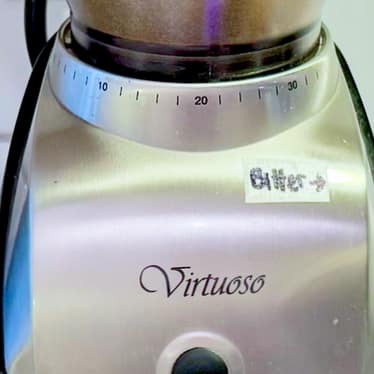
You may have spotted the tape on my grinder reminding me that to increase bitterness I need to dial down the grind and move more coarse, because for whatever reason I can never remember this and got tired of looking it up each time.
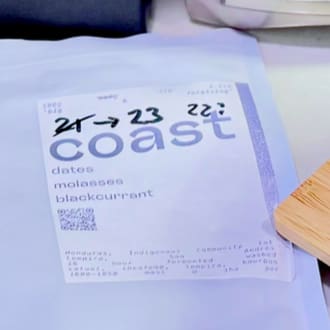
I find that the main variable I’m trying to control with the grind is bitterness. I’ve been better able to adjust acidity through the timing while brewing. If my first cup is dull I create more bitterness with a coarser grind, or adjust finer if it’s too bitter. Usually just a notch or two, and I’m rarely more than a few notches away from my starting point. I’ve also taken to noting the grind setting on each bag to help dial in and remember the ideal setting since I usually have a couple going at a time.
Brewing method
And for another Hoffman reference, I’ll say that I was using his better one-cup technique for quite a while. It’s great, and probably what most people should follow.
I’ve gone my own way after buying beans from a local specialty place that came with a different suggested technique / timing which has become my default. This is undeniably fussy though.
While waiting for the water to get to my ideal temperature, I fold and pre-soak the filter, letting the water drain into a mug so it better clings to the sides and removes any traces of paper taste. Once the water has hit temperature, I pour some around the sides of the V60 to bring up its temperature before I start brewing.
I prefer a slightly stronger 1:13.5 ratio, with 16g of beans to 220g of water. Once the hot water has fully drained from the V60 I add the grinds and shake slightly to level out, then create a central divot by pressing down into them partially with my finger.
My starting temperature for the water is 96°C. All pours are an even 55g of water, and for the first I slowly pour with the typical circling motion, and then gently swirl the V60 to encourage the water to mix evenly. I then want to cool the water down to 90°C for the next pour, and through trial and error using a Thermapen I’ve discovered the best way to do that is by vigourously swirling the kettle 10 times which gets close enough without having to measure each time.
I try and do all that quickly before the water completely soaks into the top of the grinds so I can start the second pour to bring it up to 110g total. For the third pour I want the kettle down to 88°C first which takes four quick swirls, and then again before the water completely soaks into the grinds I top up to 165g total. For the final pour it’s another 10 swirls to get down to 82°C.
It’s been a while since I timed this, but it should roughly take 1:45 from start to finish. I used to top up with a bit more water to dilute the intensity of the lower ratio I use, but I’ve adapted to it because it more closely matches the strength of pourovers at some of the cafes I frequent.
So because I’ve got it down to such a precise technique, surely I must be making consistent cups right? Not at all! The baseline is usually pretty good but during the run of any given bag I’ll definitely have a few that stand out as being better or more disappointing than the rest. There are a ton of things that can affect extraction and I still haven’t managed to stamp out all variability in my process.
The beans
I try to support as many roasters as I can by rotating through them as I need new bags. Some of my local favourites include:
And from further abroad in Canada:
- Craft 42 (Kelowna)
- Phil & Sebastian (Calgary)
- Monogram (Calgary)
- Traffic (Montreal)
I buy exclusively light roast and I generally lean toward naturally-processed beans. I’ve long been a fan of Kenyan SL28 and SL34 varietals, but after working through a coffee advent calendar last year I learned that a lot of what I like from those also shows up in washed Columbian beans. I’m not all that picky about origin these days as I’ve had plenty of surprising and interesting beans from other locales, so I’m more often going by tasting notes and smell. When I’m debating between a few bags, the one that smells best wins.
A surprising amount of new processing techniques have hit the market in recent years, and while those can be fun for a single cup I have a hard time working my way through the intensity of an entire bag of some co-ferment with cherries and coconut or whatever. Yeast-inoculated ferments also tend to be big on flavour, but those can work a little better for daily consumption. I do tend to buy thermal shock processed beans whenever I see them though, those hit the right balance of interesting flavour and drinkability for me.
Freshness of the beans is a topic I haven’t spent much time exploring. Conventional wisdom is that you need to give beans 72 hours after roasting to continue off-gassing and then consume fairly quickly after. I don’t believe in the latter anymore, as I’ve had bags go well into their second month and continue to deliver. I’m sure I’ll dig into the science behind this at some point and eventually form an opinion.
What might I change?
I’m relatively happy with this setup, though every few years there have been slight changes so I can’t pretend like I won’t keep tweaking from here. What I could see benefiting from further adjustment:
Water chemistry – we have fairly soft water that benefits from additional minerals so our better local cafes adjust their water. In the past I have played with trace amounts of calcium and magnesium, but at the home scale it’s a bit fiddly to keep that going. Still, I think about it from time to time.
Gooseneck kettle – I do struggle a bit with a consistent, low-speed pour without one. It’s manageable, but I know this part of my setup would definitely benefit from the specialized equipment.
Grinder – and as mentioned earlier, when my Virtuoso grinds its last I’ll likely consider whether or not to upgrade to a higher-end model. The jump up in price is steep and I suspect diminishing returns after a certain level, but I’ll do more research at that point.